

The American Heart Association and American Stroke Association published the 2026 Guideline for Adult Stroke Rehabilitation and Recovery on August 27, 2026. For clinicians using electrical stimulation after stroke, its message is more precise than a simple conclusion that stimulation works.
The Short Answer
The guideline grades electrical stimulation separately for each clinical goal, and the grades differ.
- Foot drop and mobility: An ankle-foot orthosis (AFO) or functional electrical stimulation (FES) is recommended to improve balance and mobility in people with poststroke hemiplegia (Class 1, Level A). This is the strongest stimulation recommendation in the guideline.
- Early shoulder subluxation: Neuromuscular electrical stimulation (NMES) is reasonable to reduce subluxation and improve arm positioning (Class 2a, Level A). NMES can also be a useful adjunct for hemiplegic shoulder pain (Class 2a, Level B-R).
- Gait, chronic arm impairment, and spasticity: FES for gait (Class 2b, Level A), NMES for chronic distal upper-limb impairment (Class 2b, Level B-R), and NMES for temporary spasticity reduction (Class 2b, Level A) carry a weaker recommendation.
- Across all of them: Stimulation sits inside repetitive, progressively graded task practice, which the guideline recommends at Class 1, Level A. It is not a substitute for that practice.
Electrical stimulation is not a single intervention with a single expected outcome. Its clinical value depends on what the clinician is trying to accomplish, the patient’s presentation, the muscles and movements being targeted, the treatment dose, and whether stimulation is integrated into relevant practice.
That distinction matters. A treatment used to assist foot clearance during walking should not be evaluated the same way as a protocol intended to produce lasting motor improvement after stimulation is removed. Evidence on shoulder subluxation, distal upper-extremity impairment, gait, and spasticity answers different clinical questions.
The question is not whether electrical stimulation works. It is whether a specific approach fits a specific therapeutic goal, is delivered at an appropriate dose, and is paired with the practice needed to reach that goal.
Every Electrical Stimulation Recommendation in the 2026 Guideline
The table below lists each recommendation that applies electrical stimulation to movement, shoulder pain, or tone, from strongest to weakest.
| Clinical goal | What the guideline recommends | Class | Level |
|---|---|---|---|
| Balance and mobility in poststroke hemiplegia | Using an AFO or FES is recommended to improve balance and mobility. | 1 | A |
| Shoulder subluxation or minimal movement, first few months | It is reasonable to consider NMES to reduce subluxation and improve arm positioning. | 2a | A |
| Hemiplegic shoulder pain | NMES, among other adjuncts to standard rehabilitation, can be useful to reduce shoulder pain and improve upper-extremity range of motion. | 2a | B-R |
| Gait | FES of the affected leg combined with an exercise program may be considered as a restorative therapy to improve gait kinematics, walking endurance, balance, and mobility. | 2b | A |
| Chronic moderate-to-severe distal upper-limb impairment | It may be reasonable to consider NMES to improve motor impairment and functional activities. | 2b | B-R |
| Spasticity | NMES or vibration applied to spastic muscles may be reasonable as an adjunct to rehabilitation to temporarily improve spasticity. | 2b | A |
Source: Richards et al., 2026. Wording is condensed; see the full guideline for exact language and supporting evidence. The guideline also grades electrical stimulation for urinary incontinence (Class 2b, Level B-R) and as a guidance tool for botulinum toxin injection (Class 1, Level B-R). Both fall outside the scope of this article.
How to Read Class of Recommendation and Level of Evidence
The guideline rates every recommendation on two separate scales. Class of Recommendation (COR) reflects strength, meaning how clearly the benefit outweighs the risk. Level of Evidence (LOE) reflects the quality and type of data behind it.
| Class | Strength | Typical wording |
|---|---|---|
| 1 | Strong | “is recommended” |
| 2a | Moderate | “is reasonable,” “can be useful” |
| 2b | Weak | “may be reasonable,” “may be considered” |
| 3: No Benefit | Moderate, against | “is not recommended” |
| 3: Harm | Strong, against | “is not recommended,” “potentially harmful” |
| Level | Quality and type of evidence |
|---|---|
| A | High-quality evidence from more than one randomized controlled trial (RCT), or meta-analyses of high-quality RCTs |
| B-R | Moderate-quality evidence from one or more RCTs |
| B-NR | Moderate-quality evidence from nonrandomized studies |
| C-LD | Limited data |
| C-EO | Consensus of expert opinion |
A high level of evidence does not mean an intervention is strongly recommended for every patient. FES for gait shows why: it carries Level A evidence and a Class 2b recommendation. There is a substantial body of randomized research, and its results are mixed. Clinicians still need to read the evidence against the specific indication and the individual’s goals.
Five Clinical Takeaways
1. Does the guideline recommend FES for gait after stroke?
It says FES may be considered. Specifically, FES of the affected leg, combined with an exercise program, may be considered as a restorative therapy to improve gait kinematics, walking endurance, balance, and mobility (COR 2b, LOE A).
The word combined is clinically important. The recommendation does not frame stimulation as a stand-alone intervention. It places FES within an exercise program that gives the patient repeated, goal-directed movement.
The guideline describes the evidence for a restorative effect as mixed. Studies differ in stimulation site, including single-nerve peroneal stimulation versus multimuscle approaches, as well as timing, dose, and patient characteristics, and the optimal combination remains unclear. A 2021 systematic review found that peroneal-nerve FES combined with supervised physiotherapy improved gait speed more than physiotherapy alone, but the authors rated the evidence as low quality and advised careful interpretation (Jaqueline da Cunha et al., 2021).
2. Should clinicians choose FES or an AFO for foot drop?
The guideline doesn’t make it a contest. For people with poststroke hemiplegia, using an AFO or FES is recommended to improve balance and mobility (COR 1, LOE A). That is the strongest recommendation in the guideline for electrical stimulation as a therapy.
The supporting evidence shows comparable effects. A meta-analysis comparing FES with ankle-foot orthoses found equivalent therapeutic effects on walking performance (Prenton et al., 2018), and the guideline notes that assistive FES applied during walking may produce functional gains comparable to an AFO.
Selection should account for the individual’s motor presentation, skin integrity, cognition, tolerance, goals, environment, ability to use the device consistently, and the intended role of the intervention.
3. When does the guideline support NMES for the upper extremity?
It depends on timing and target. The guideline makes three distinct upper-extremity statements:
- Early subluxation or minimal movement: In people with minimal volitional movement or shoulder subluxation within the first few months after stroke, it is reasonable to consider NMES to reduce subluxation and improve arm positioning (COR 2a, LOE A).
- Hemiplegic shoulder pain: NMES is one of several adjuncts to standard rehabilitation that can be useful to reduce shoulder pain and improve upper-extremity range of motion (COR 2a, LOE B-R).
- Chronic distal impairment: For people with chronic moderate-to-severe distal upper-limb impairment, NMES may be reasonable to improve motor impairment and functional activities (COR 2b, LOE B-R).
These recommendations reinforce the need to define the target. Reducing subluxation, eliciting movement when voluntary activation is limited, managing shoulder pain, and improving functional hand use are related but distinct goals. Each requires appropriate patient selection, stimulation parameters, electrode placement, progression, and outcome measurement.
4. How does task practice change what stimulation can do?
Across the guideline, electrical stimulation sits within a broader framework built on sufficient amounts and intensity of task practice. Repetitive, progressively graded practice of functional tasks is recommended to improve ADL performance and motor function (COR 1, LOE A).
A 2026 multisite randomized controlled trial shows why treatment design matters. Knutson and colleagues randomized 132 people six to 24 months after stroke, all with moderate-to-severe hand weakness, to contralaterally controlled functional electrical stimulation (CCFES), cyclic NMES, or task-oriented training without stimulation. All three groups were prescribed the same schedule: 10 home exercise sessions a week plus 22 sessions of functional task practice in the lab over 12 weeks (Knutson et al., 2026).
At six months after treatment, the groups did not differ on the primary dexterity outcome, the Box and Blocks Test. CCFES did produce greater improvement in upper-extremity motor impairment, measured by the Fugl-Meyer assessment, than both cyclic NMES and task-oriented training, and greater improvement on the Action Research Arm Test than task-oriented training. Sixty-seven percent of CCFES participants reached the Fugl-Meyer responder threshold, compared with 42 percent for cyclic NMES and 38 percent for task-oriented training.
Because the practice schedule was matched across groups, the differences point to how stimulation was controlled and paired with practice. The trial is not evidence that every stimulation protocol produces the same result, and CCFES did not improve dexterity more than the comparisons. It is evidence that the design of the stimulation influences which outcomes improve.
5. Does NMES reduce spasticity for the long term?
The guideline supports a temporary effect. NMES or vibration applied to spastic muscles may be reasonable as an adjunct to rehabilitation therapy to temporarily improve spasticity (COR 2b, LOE A). A short-term change in measured spasticity should not be presented as a sustained change in the underlying hypertonia.
Clinicians should identify the functional problem they are trying to address, such as positioning, comfort, range of motion, hygiene, gait, or task performance, and choose outcome measures that match it.
What Is the Difference Between Assistive and Restorative FES?
The guideline uses both terms. It describes FES combined with exercise as a restorative therapy, and it discusses assistive FES applied during walking alongside the AFO. The distinction is useful when interpreting the evidence.
- Assistive FES supports performance while stimulation is being delivered, such as assisting ankle dorsiflexion during walking.
- Restorative FES is used during repeated practice with the goal of producing motor improvements that remain when stimulation is no longer delivered.
Both goals can be valuable. They answer different clinical questions and should be evaluated with different outcomes. Immediate improvement during stimulation does not by itself demonstrate therapeutic carryover. Conversely, the absence of a lasting restorative effect does not mean an assistive application lacks value for mobility or participation.
What This Means for Integrated FES in Practice
The direction of the guideline aligns with a practical principle: stimulation is most meaningful when it helps a person take part in more relevant, repetitive, and progressively challenging movement, with the treatment plan built around individual goals.
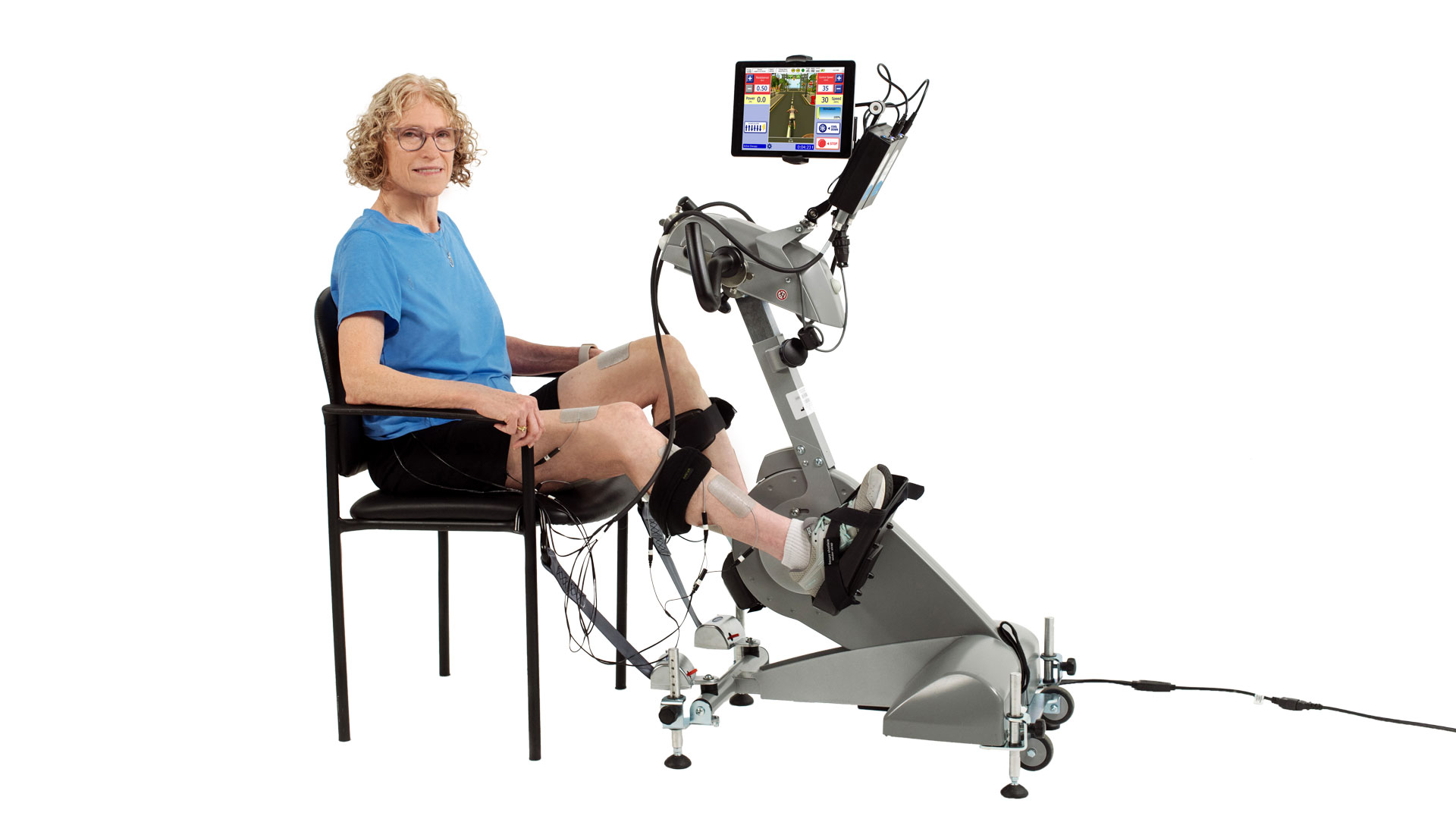
Restorative Therapies’ FDA-cleared integrated FES systems are designed to support this approach in different therapeutic contexts. Xcite2 pairs multi-channel integrated FES with 40+ pre-programmed, task-specific upper- and lower-extremity activities, including activities that support ADL rehabilitation, and the Xcite2 Expansion Pack adds eight more. The RT300 supports massed-practice, progressive-resistance cycling with integrated FES. These systems serve different treatment purposes and should be selected and programmed based on clinical assessment, precautions, goals, and the plan of care.
The guideline does not endorse a specific commercial system. It does reinforce the clinical reasoning that should guide technology use: define the indication, match the intervention to the desired outcome, integrate stimulation with active practice, progress the challenge, and measure what matters.


The Clinical Question to Ask
Instead of asking, “Does electrical stimulation work?” clinicians can ask:
- What specific impairment, activity, or participation goal are we targeting?
- Is the purpose assistive, restorative, or both?
- Which muscles and movement sequence need to be activated?
- How will stimulation be integrated with repetitive, task-specific practice?
- What dose and progression are appropriate for this patient?
- Which outcome will show whether the intervention is helping?
Those questions move the discussion beyond whether a muscle contracts. They focus treatment on meaningful movement, measurable goals, and the person’s priorities throughout stroke rehabilitation and recovery. For more on applying them to tone management, see Lower Limb Spasticity Management: Using FES to Unlock Performance and Upper Limb Spasticity Management in Neurorehabilitation.
Clinical note: This article is for professional education and does not replace individual clinical judgment, device labeling, or the full AHA/ASA guideline.
Frequently Asked Questions About Electrical Stimulation After Stroke
What does the 2026 AHA/ASA stroke rehabilitation guideline say about electrical stimulation?
It grades each use separately. The strongest recommendation is Class 1: an AFO or FES is recommended to improve balance and mobility in people with poststroke hemiplegia. NMES for early shoulder subluxation and as an adjunct for shoulder pain rates Class 2a. FES for gait, NMES for chronic distal arm impairment, and NMES for temporary spasticity reduction rate Class 2b.
Is FES better than an ankle-foot orthosis for foot drop after stroke?
The guideline does not rank one above the other. It recommends an AFO or FES to improve balance and mobility (Class 1, Level A), and a meta-analysis found equivalent therapeutic effects on walking. The right choice depends on motor presentation, skin integrity, cognition, tolerance, goals, environment, and whether the person can use the device consistently.
Does NMES help shoulder subluxation after stroke?
For selected patients, yes. In people with minimal volitional movement or shoulder subluxation within the first few months after stroke, the guideline says it is reasonable to consider NMES to reduce subluxation and improve arm positioning (Class 2a, Level A).
Does electrical stimulation reduce spasticity after stroke?
Temporarily. The guideline says NMES or vibration applied to spastic muscles may be reasonable as an adjunct to rehabilitation to temporarily improve spasticity (Class 2b, Level A). It should not be presented as a lasting change in hypertonia.
What is contralaterally controlled FES?
Contralaterally controlled FES (CCFES) lets a person control stimulation to the affected hand by opening the less-affected hand, combining bilateral movement, FES, and task-specific practice. In a 2026 multisite trial, CCFES reduced upper-extremity impairment more than cyclic NMES or task-oriented training, but it did not improve dexterity more.
For broader clinical questions about integrated FES therapy, see our Clinician FAQs.
About the Authors
Laurie Magerfleisch, PT, DPT, is a Senior Clinical Educator at Restorative Therapies in the US.
LeeAnn Walb, MSOT, OTR/L, CBIS, is a Clinical Educator at Restorative Therapies in Australia.
References
- Jaqueline da Cunha M, Rech KD, Salazar AP, Pagnussat AS. “Functional Electrical Stimulation of the Peroneal Nerve Improves Post-stroke Gait Speed When Combined With Physiotherapy: A Systematic Review and Meta-analysis.” Annals of Physical and Rehabilitation Medicine, vol. 64, no. 1, 2021, p. 101388. doi:10.1016/j.rehab.2020.03.012
- Knutson JS, Friedl AS, Hansen KM, et al. “Contralaterally Controlled Functional Electrical Stimulation for Upper Extremity Recovery Following Stroke: A Multisite Randomized Controlled Trial.” Stroke, vol. 57, no. 2, 2026, pp. 338-348. doi:10.1161/STROKEAHA.125.052891
- Prenton S, Hollands KL, Kenney LPJ, Onmanee P. “Functional Electrical Stimulation and Ankle Foot Orthoses Provide Equivalent Therapeutic Effects on Foot Drop: A Meta-analysis Providing Direction for Future Research.” Journal of Rehabilitation Medicine, vol. 50, no. 2, 2018, pp. 129-139. doi:10.2340/16501977-2289
- Richards LG, Ifejika NL, Stein J, et al. “2026 Guideline for Adult Stroke Rehabilitation and Recovery: A Guideline From the American Heart Association and American Stroke Association.” Stroke, vol. 57, 2026, published online August 27, 2026. doi:10.1161/STR.0000000000000536
Want to learn more about how the RT300 and Xcite2 therapy systems can improve patient outcomes?
Visit restorative-therapies.com to explore how Restorative Therapies supports clinicians and patients in the neurorecovery journey. Explore how the RT300 and Xcite2 therapy systems bring integrated FES into cycling and task-specific functional activity.
Contact Restorative Therapies to schedule a demonstration or clinical in-service. Outside the US? See our international page.