

Author: Laurie Magerfleisch, PT, DPT
Restorative Therapies was founded in 2004 with a clear purpose: to help people with neurological impairments and critical illness achieve their full recovery potential.
How Restorative Therapies Started
The company’s story began with a small research and development team working on functional electrical stimulation, or FES, technology. At the time, rehabilitation options for individuals with paralysis and other neurological impairments were often limited. The founding team recognized a major unmet need: people needed more than passive care. They needed opportunities to stay active, preserve their health, and participate in meaningful, repetitive movement even when voluntary muscle control was limited.
That belief became the foundation of Restorative Therapies.
Dr. John McDonald, Christopher Reeve and Activity-Based Therapy
The early vision for Restorative Therapies was also shaped by the involvement of John W. McDonald, MD, PhD, whose work in spinal cord injury rehabilitation helped bring national attention to activity-based restorative therapy and the use of functional electrical stimulation. Dr. McDonald began working with Christopher Reeve in 1999, four years after Reeve’s spinal cord injury, and Reeve’s highly publicized rehabilitation helped challenge long-held assumptions about what might be possible years after injury. Rather than viewing paralysis only through the lens of compensation, Dr. McDonald emphasized the importance of repeated, activity-based movement and the potential role of FES in helping individuals with neurological injury remain physically active and engaged in rehabilitation.
That perspective became an important part of Restorative Therapies’ early identity. When the company was founded in Baltimore in 2004, Dr. McDonald was involved as part of the early ownership and clinical vision behind the company, helping connect the emerging technology with a broader rehabilitation philosophy: people with neurological impairments needed access to meaningful, repetitive, technology-supported activity, not only in research settings, but in clinics and homes.
The RT300: FDA-Cleared FES Cycling Since 2005
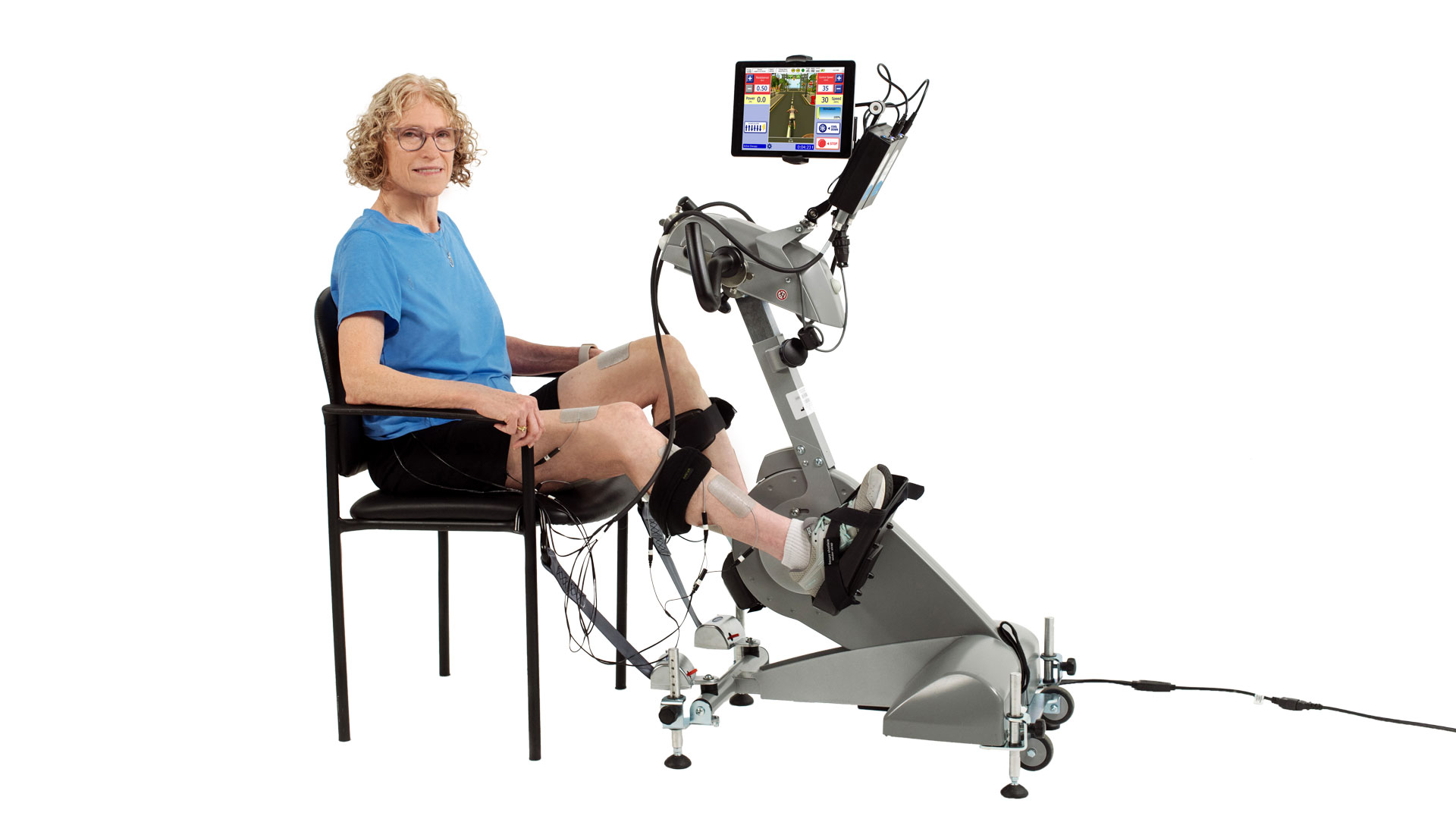
In 2005, Restorative Therapies received FDA clearance for the RT300 FES Therapy System, marking an important step in bringing integrated FES massed-practice activity into clinical and home rehabilitation settings. The RT300 was designed to pair electrical stimulation with coordinated movement, allowing individuals with weakness or paralysis to participate in the activity without requiring a transfer onto a separate seat. Over time, the system continued to evolve, including additional FDA clearance in 2017 for expanded functionality such as wide pulse stimulation and muscle re-education.
From the beginning, the goal was not simply to build equipment. The goal was to create access to activity-based therapy: therapy that helps support muscle health, circulation, range of motion, and engagement in movement. Restorative Therapies’ FDA-cleared systems are intended to support goals including prevention or reduction of disuse atrophy, relaxation of muscle spasms, improved local circulation, maintenance or improvement of range of motion, and muscle re-education.
From RT300 to Xcite2: How the Product Line Grew
As the company grew, so did its product line. The early RT300 system became part of a broader evolution in FES-integrated activity. RTILink added the ability to track patient sessions and outcomes over time, creating new opportunities for clinicians, researchers, and patients to monitor progress. Additional systems followed, including options for arm cycling, supine cycling, and hybrid movement-based systems.
In 2017, Restorative Therapies expanded further with Xcite, a task-specific FES system designed to support functional activities commonly used in therapy. Rather than focusing only on massed practice activity, Xcite helped clinicians apply multi-channel stimulation during coordinated activities such as reaching, grasping, transfers, posture, and other therapy-based movements. Xcite received FDA 510(k) clearance in 2016, and Xcite2 launched in 2021 with updates intended to improve clinical usability, flexibility, and treatment efficiency.
Restorative Therapies Today
The company’s history also reflects the broader growth of advanced neurorehabilitation. What began as a small team with a focused idea has grown into a global organization supporting clinics, clinicians, researchers, and individuals using FES technology in rehabilitation and at home. Its systems are now in more than 1,000 clinics and 5,000 homes worldwide.
Today, Restorative Therapies remains focused on advancing activity-based rehabilitation through technology, education, clinical support, and continued innovation. The company’s work is grounded in a simple but powerful idea: people with neurological impairments deserve access to therapy that helps them stay active, engaged, and connected to their recovery.
Much of that work is still with the spinal cord injury community. Over the years, Restorative Therapies worked with organizations including the Christopher & Dana Reeve Foundation. Today it partners with SPINALpedia and the North American Spinal Cord Injury Consortium (NASCIC), including work with NASCIC on integrated FES education for the SCI community. The company started with a question: what is still possible years after a spinal cord injury? More than 20 years later, it is still the question behind the work.
From its founding in 2004 to the continued development of RT300, Xcite, Xcite2, and home-based therapy options, Restorative Therapies has grown around a shared commitment to helping individuals move toward their greatest possible recovery potential.
That commitment remains at the heart of the company today.
Frequently Asked Questions
When was Restorative Therapies founded?
Restorative Therapies was founded in 2004 in Baltimore, Maryland, to help people with neurological impairments and critical illness achieve their full recovery potential.
What was Restorative Therapies’ first FDA-cleared system?
The RT300 FES Therapy System, cleared by the FDA in 2005. It pairs functional electrical stimulation with coordinated cycling movement, and users can take part without transferring onto a separate seat.
What is functional electrical stimulation (FES)?
FES uses electrical stimulation to activate muscles, so people with weakness or paralysis can take part in repetitive movement even when voluntary muscle control is limited.
What is the difference between the RT300 and Xcite2?
The RT300 pairs FES with cycling for massed-practice activity. Xcite2 applies multi-channel stimulation during task-specific therapy activities such as reaching, grasping, transfers and posture.
How is Restorative Therapies connected to spinal cord injury rehabilitation?
The company’s early vision was shaped by John W. McDonald, MD, PhD, whose spinal cord injury work, including his work with Christopher Reeve, helped bring national attention to activity-based therapy and FES.
Want to learn more about how the RT300 and Xcite2 therapy systems can improve patient outcomes?
Visit restorative-therapies.com to explore how Restorative Therapies supports clinicians and patients in the neurorecovery journey. Explore how the RT300 and Xcite2 therapy systems bring integrated FES into cycling and task-specific functional activity.
Contact Restorative Therapies to schedule a demonstration or clinical in-service. Outside the US? See our international page.