
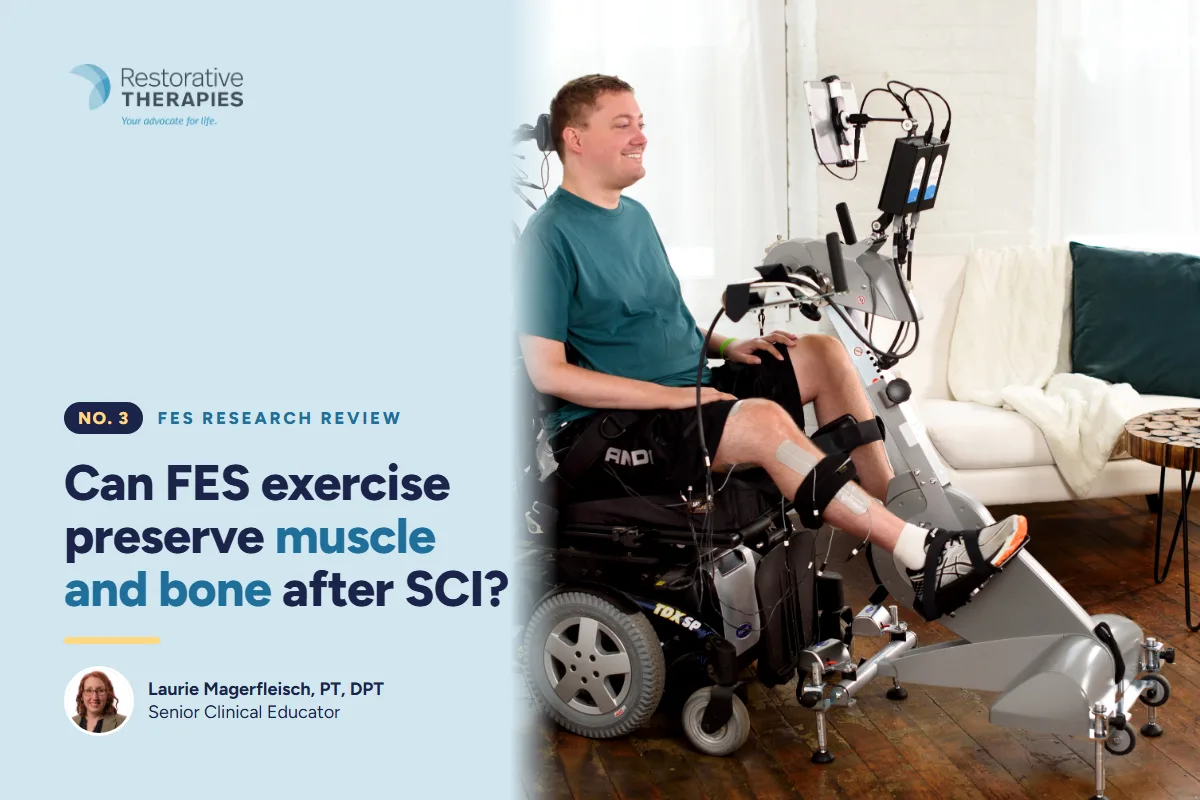
In this installment of the FES Research Review series, we’re looking at a 2023 systematic review by Ibitoye and colleagues examining the effects of FES-supported lower extremity exercise on muscle and bone health after SCI.
Following spinal cord injury (SCI), the loss of regular muscle activity and mechanical loading contributes to significant changes in muscle and bone health. Muscle atrophy can develop rapidly, while bone mineral density declines, particularly in the lower extremities, increasing the risk of fractures.
We often discuss muscle preservation as a benefit of FES cycling, but what about bone health? Can restoring muscle contractions and mechanical loading help prevent some of these secondary complications?
What Did the Researchers Find?
The review included 78 studies examining different forms of lower extremity exercise, with and without FES:
- 12 studies involving standing
- 49 studies involving cycling, rowing, or knee extension exercises
- 17 studies involving walking
The researchers focused primarily on changes in muscle mass, muscle volume, and bone mineral density.
Overall, the findings suggest that FES-supported exercise may help preserve muscle and bone health after SCI, although the evidence was considerably stronger for muscle adaptations than for bone.
Muscle Health: Encouraging Evidence
One of the more consistent findings was that FES-supported exercise can help preserve or increase muscle mass following SCI. Studies involving FES cycling, resistance training, standing, and walking reported improvements in muscle cross-sectional area, muscle thickness, or muscle volume.
These findings are particularly important given how rapidly muscle atrophy develops following SCI. Restoring muscle contractions through FES provides an opportunity to activate muscles that may otherwise receive very little regular activity.
Bone Health: A More Complicated Picture
The findings for bone health were less consistent. Some studies demonstrated that FES-supported exercise could slow bone loss or improve bone mineral density, while others found little or no significant benefit.
One important consideration is that muscle contractions alone may not provide sufficient mechanical loading to produce meaningful bone adaptations. The type of exercise, magnitude of loading, and duration of training may all influence the response.
Bone adaptations may also be site-specific: the muscles being activated and the mechanical forces generated during exercise may determine which bones receive sufficient loading to respond.
The researchers noted that improvements in muscle health generally occurred more readily than changes in bone density, suggesting that bone adaptations may require longer or more intensive training.
Do Timing and Dosage Matter?
One of the most interesting findings was the importance of introducing exercise early following injury. The authors found that programs initiated within the first three months after SCI appeared particularly beneficial for preserving muscle and bone health, especially when exercise was performed:
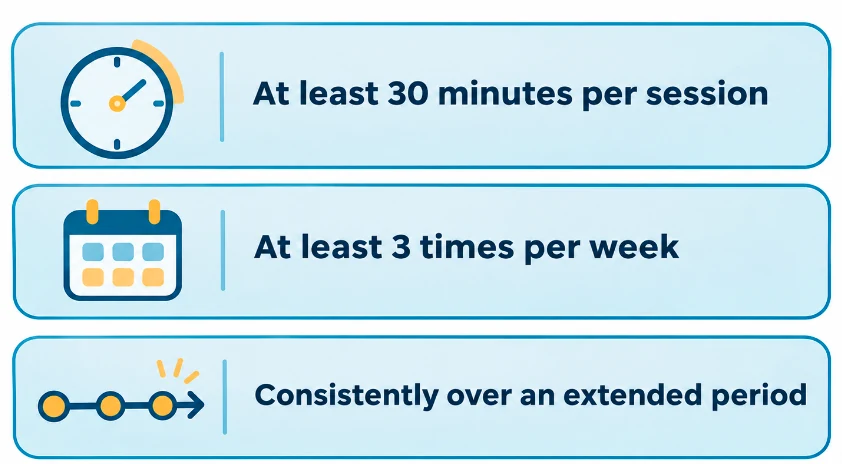
Some of the studies involved programs lasting up to 24 months. These findings reflect patterns observed across studies rather than an established minimum exercise prescription. The optimal dosage, particularly for bone health, remains unclear.
A previous narrative review by Rosley and colleagues (2019), focused specifically on FES cycling, also highlighted the importance of training dosage. Improvements in muscle size and strength were reported with programs generally involving 45–60-minute sessions, three times per week. The authors also identified cycling cadence as a potential factor, with some studies demonstrating greater muscle adaptations at lower cadences.
Importantly, these improvements were observed in individuals with chronic SCI as well. While introducing exercise early may help limit the initial loss of muscle and bone, meaningful muscle adaptations remain possible years after injury.
However, these findings should not be interpreted as a definitive exercise prescription. The studies varied considerably in their methods, exercise modalities, and training protocols, making it difficult to determine an optimal dosage.
What Does This Mean for Clinical Practice?
This review reinforces the importance of restoring muscle activity following SCI, even when voluntary movement is limited. There is encouraging evidence that FES-supported exercise can help preserve muscle mass and reduce some of the effects of prolonged immobility. However, we need to be more cautious when discussing bone health.
Not all forms of FES exercise produce the same mechanical loading, and improvements in muscle size do not necessarily mean that bone density is improving.
For clinicians, this means considering the specific goals of exercise, the type and intensity of muscle contractions being generated, and whether the intervention provides an appropriate stimulus for the desired adaptation.
So, What Do I Want You to Take Away from This?
FES-supported exercise offers an important opportunity to address muscle atrophy after SCI, with emerging evidence suggesting that some forms of training may also help preserve bone health.
The strongest message from this review is the importance of early intervention, sufficient exercise dosage, and continued participation over time. Equally important, beginning exercise later after injury does not mean the opportunity for muscle adaptation has been lost.
While the evidence is not yet strong enough to establish an optimal protocol for bone preservation, it supports looking beyond traditional functional recovery goals and considering the long-term musculoskeletal health of individuals living with SCI.
Applying This Research with the RT300
This review points to two practical needs: getting muscles working early after injury, and keeping training consistent over months rather than weeks.
The RT300 is a physician-prescribed, FDA Class II integrated FES cycling system for clinic and home use. It is cleared to help prevent muscle atrophy from disuse, relax muscle spasms, improve local circulation, maintain or increase range of motion, and facilitate muscle re-education. Home use can help patients keep training between therapy visits over the long periods these studies describe. Stimulation parameters and cadence are set for each patient by the clinical team.
The RT300 is not cleared to treat bone loss, and this review does not establish that FES cycling improves bone density. Clinicians can refer a patient for home therapy on our Home Therapy Hub.
Frequently Asked Questions
Can FES exercise prevent muscle loss after spinal cord injury?
The evidence is encouraging. In a 2023 systematic review of 78 studies, FES-supported cycling, resistance training, standing, and walking were linked to preserved or increased muscle mass, measured as cross-sectional area, thickness, or volume. The evidence for muscle was considerably stronger than for bone.
Does FES cycling improve bone density after SCI?
The findings are mixed. Some studies showed FES-supported exercise slowed bone loss or improved bone mineral density, while others found little or no benefit. Muscle contractions alone may not load bone enough, and the effect may depend on the type of exercise, the forces generated, and which bones are loaded.
When should FES exercise start after spinal cord injury?
Programs that began within the first three months after injury appeared particularly beneficial for preserving muscle and bone. Starting later is still worthwhile: a 2019 review of FES cycling reported muscle size and strength gains in people with chronic SCI as well.
How often and for how long was FES exercise done in these studies?
Common patterns were at least 30 minutes per session, at least three times per week, continued over an extended period, with some programs lasting up to 24 months. These are patterns across studies, not an established prescription, and the optimal dose for bone health remains unclear.
Does cycling cadence matter for muscle gains?
It may. A 2019 narrative review of FES cycling found some studies reported greater muscle adaptations at lower cadences, with programs generally using 45–60-minute sessions three times per week.
Do I need a prescription for the RT300?
Yes. All Restorative Therapies devices, including the RT300, require a prescription. Your clinician can help decide whether integrated FES therapy is appropriate for you. Contact Restorative Therapies at 1-800-609-9166 to learn more.
References
Ibitoye, M. O., Hamzaid, N. A., & Ahmed, Y. K. (2023). Effectiveness of FES-supported leg exercise for promotion of paralysed lower limb muscle and bone health: A systematic review. Biomedizinische Technik/Biomedical Engineering, 68(4), 329–350. https://doi.org/10.1515/bmt-2021-0195
Rosley, N., Hamzaid, N. A., Hasnan, N., Davis, G. M., & Manaf, H. (2019). Muscle size and strength benefits of functional electrical stimulation-evoked cycling dosage in spinal cord injury: A narrative review. Sains Malaysiana, 48(3), 607–612. https://doi.org/10.17576/jsm-2019-4803-13
Want to learn more about how the RT300 and Xcite2 therapy systems can improve patient outcomes?
Visit restorative-therapies.com to explore how Restorative Therapies supports clinicians and patients in the neurorecovery journey. Explore how the RT300 and Xcite2 therapy systems bring integrated FES into cycling and task-specific functional activity.
Contact Restorative Therapies to schedule a demonstration or clinical in-service. Outside the US? See our international page.
We are your advocate for life.