

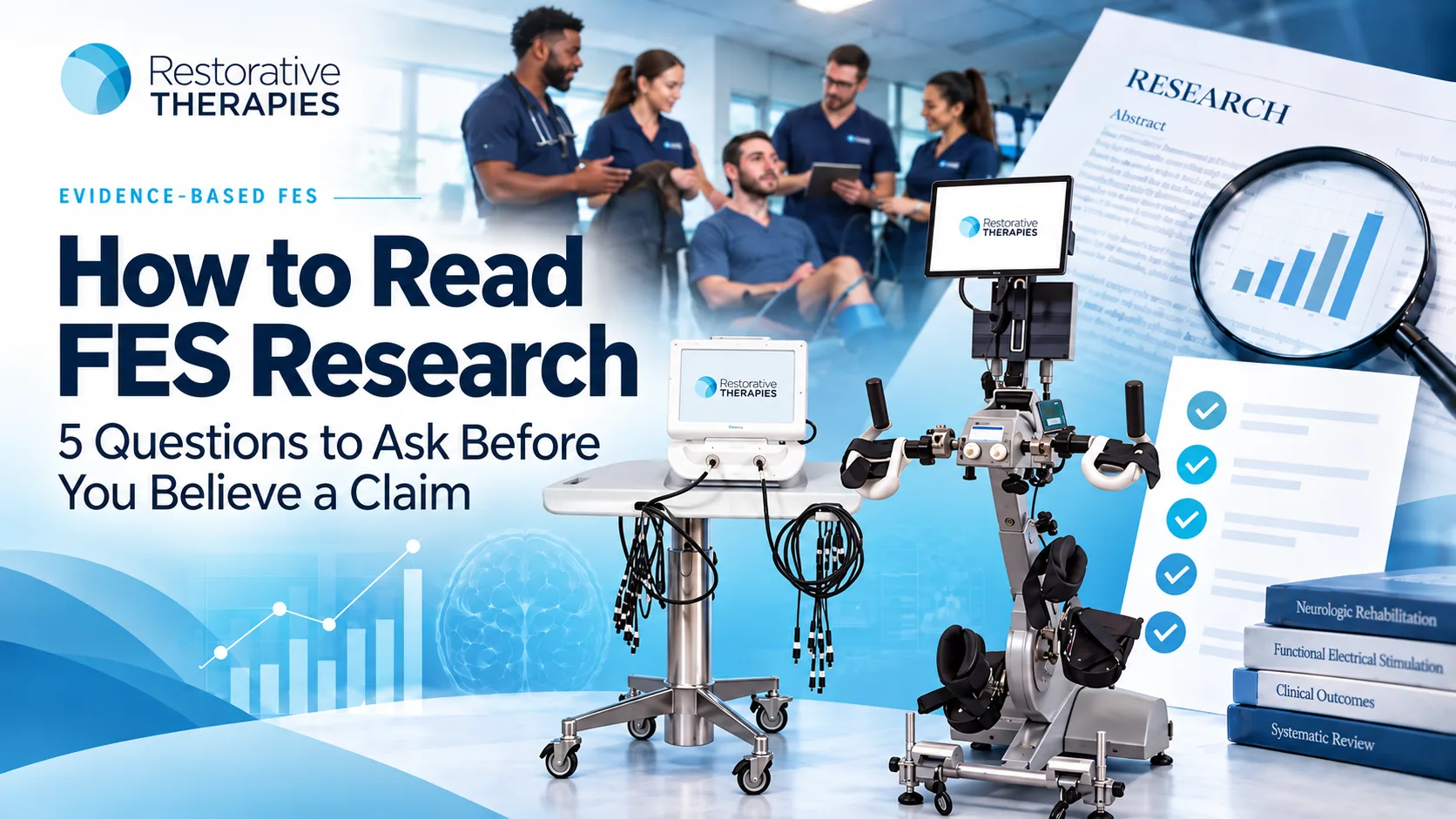
Functional electrical stimulation has one of the strongest evidence bases in neurorehabilitation, but not every study, poster, or chart shared online deserves equal weight. Whether you are a clinician, a person with a neurological condition, or a caregiver, these five questions will help you evaluate any FES claim.
1. Is it peer-reviewed, or a poster, abstract, or marketing page?
Peer review is the minimum bar for trustworthy science. Conference posters and abstracts are preliminary communications. They have not been scrutinized for methods, statistics, or conflicts of interest. When a bold claim rests on a poster, and the poster itself is not shown, treat it as a hypothesis, not a conclusion.
2. How many people were studied?
Sample size matters. Studies of three or four participants can generate interesting pilot data and trends, but they cannot establish that one therapy outperforms another or be generalized. Look for randomized controlled trials, systematic reviews, meta-analyses, and studies replicated across multiple centers and larger populations.
3. What is being measured: a surrogate metric or a clinical outcome?
A single measurement, like mechanical efficiency over a short exercise bout, is not the same as a meaningful outcome. In neurorehabilitation, outcomes that matter include muscle cross-sectional area, cardiovascular health, spasticity, range of motion, and function over time. Ask whether the study measured something that changes lives.
4. Who funded the work, and who benefits from the claim?
Independent, multi-center research carries more weight than company-commissioned comparisons. When a manufacturer publishes its own “versus” article, or cites a study about its own device, apply extra scrutiny.
Why This Matters
Families making decisions about FES therapy deserve the full picture. The strongest FES evidence base in the field, spanning two decades, hundreds of peer-reviewed participants, and use in the nation’s top rehabilitation hospitals, belongs to therapies that have earned clinicians’ trust over time, not those with the loudest single claim.
Want to learn more about how the RT300 and Xcite2 therapy systems can improve patient outcomes?
Visit restorative-therapies.com to explore how Restorative Therapies supports clinicians and patients in the neurorecovery journey. Explore how the RT300 and Xcite2 therapy systems bring integrated FES into cycling and task-specific functional activity.
Contact Restorative Therapies to schedule a demonstration or clinical in-service. Outside the US? See our international page.
We are your advocate for life.


