
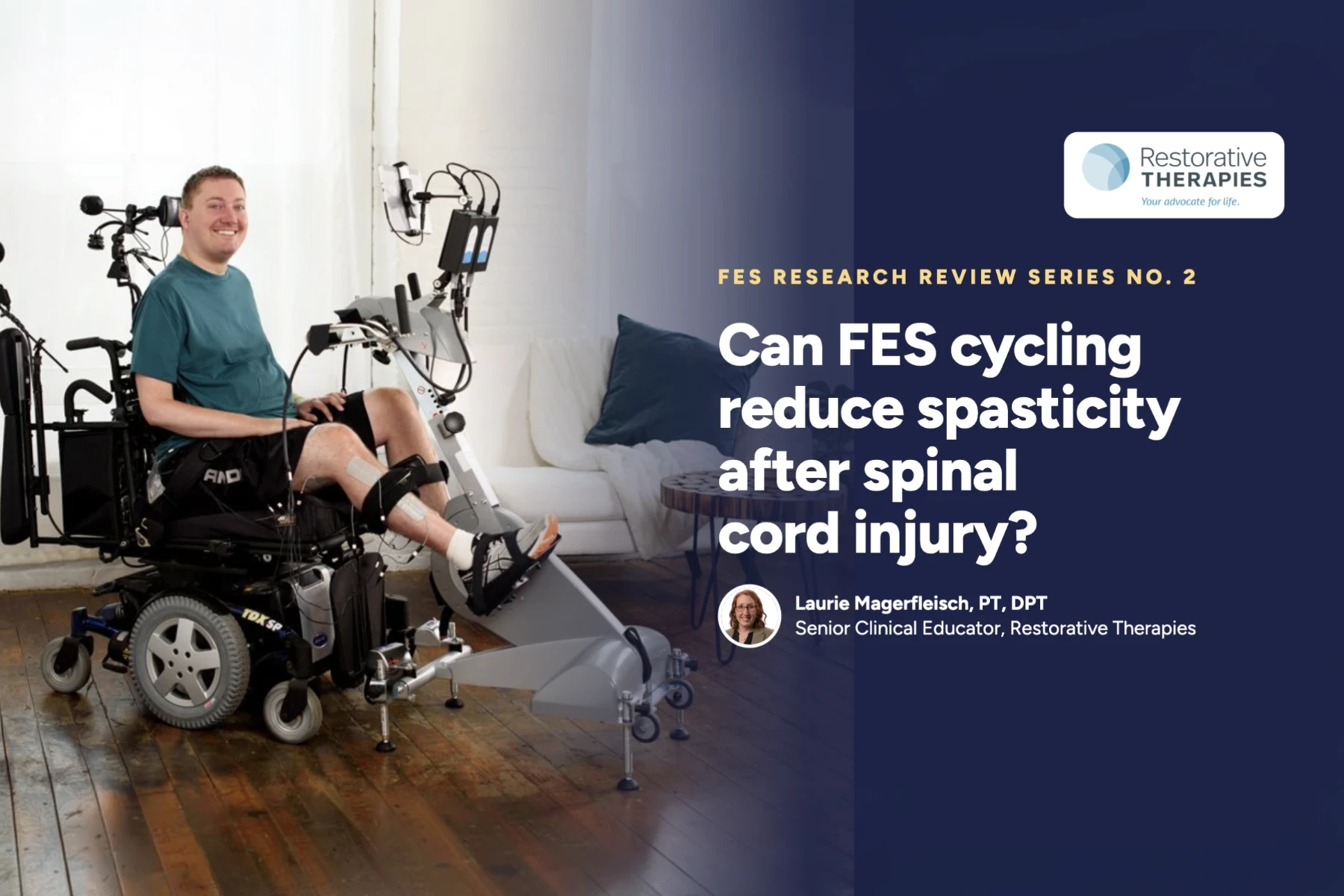
In this installment of the FES Research Review series, we’re looking at a 2025 systematic review by Couper and Smith that examined the effects of FES cycling on spasticity after SCI, including the potential influence of treatment duration and stimulation parameters.
Spasticity is a common complication after spinal cord injury (SCI), affecting an estimated 65–78% of individuals (Couper & Smith, 2025). While some degree of spasticity may be beneficial, excessive spasticity can interfere with positioning, transfers, sleep, comfort, and daily care and activities.
We often discuss spasticity reduction as a potential benefit of FES cycling, but what does the research actually tell us?
What Did the Researchers Find?
The review included 16 studies involving 203 individuals with SCI, ranging in age from 7 to 80 years. Participants included individuals with both complete and incomplete injuries, with considerable variation in injury level and time since injury.
Ten of the 16 studies reported some reduction in spasticity following FES cycling, with six demonstrating statistically significant improvements. However, several studies found no significant changes, and one reported increased spasticity on objective measures despite participants reporting subjective improvements.
The authors concluded that while the findings are encouraging, the overall evidence remains inconclusive.
Immediate vs. Long-Term Effects
One of the more interesting findings was the difference between short-term and sustained changes in spasticity. Several studies demonstrated reductions in spasticity immediately following FES cycling, suggesting that even a single session may provide temporary relief. Evidence for longer-term benefits was more limited. However, one higher-quality study reported significant reductions in spasticity following a program of:
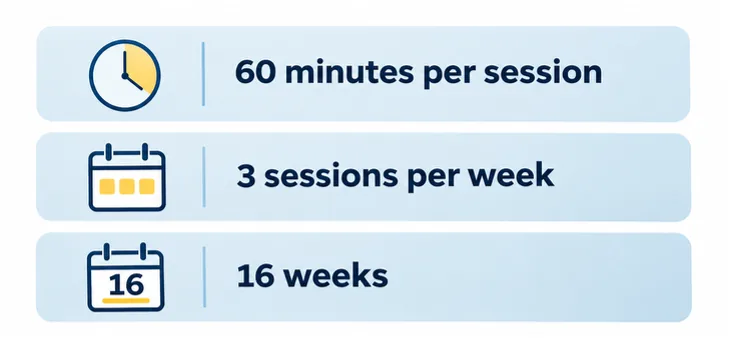
Improvements were observed at both three and six months after the start of the intervention.
This is an important distinction. While shorter sessions may provide temporary reductions in spasticity, we don’t yet know what dosage is needed to produce sustained changes.
Does Stimulation Dosage Matter?
There was considerable variation in stimulation parameters across the studies. Most used frequencies between 20 and 30 Hz, with amplitudes often exceeding 100 mA. Pulse widths varied considerably.
Unfortunately, the researchers were unable to identify an optimal combination of stimulation frequency, pulse width, and amplitude for spasticity management. This reinforces the importance of considering more than just the presence of electrical stimulation. Muscle recruitment, exercise duration, frequency of training, and individual tolerance may all influence the response.
What Does This Mean for Clinical Practice?
There is evidence that FES cycling can reduce spasticity after SCI, at least temporarily, and longer-term improvements may be possible with consistent training. However, spasticity is complex, and a reduction in an Ashworth score doesn’t necessarily tell us whether a patient is experiencing meaningful improvements in daily life.
For clinicians, it is worth considering not only changes in muscle tone, but also whether those changes translate into improved comfort, positioning, sleep, ease of caregiving, or participation in activities. For a practical framework that uses FES to move from managing spasticity toward function, see Lower Limb Spasticity Management: Using FES to Unlock Performance.
This review also highlights the importance of using both clinical assessments and patient-reported outcomes. In one study, participants reported reduced spasticity even though objective measures suggested an increase.
So, What Do I Want You to Take Away from This?
FES cycling shows promise as part of a spasticity management program, but we still need better evidence to understand the optimal dosage, how long the effects last, and which patients are most likely to benefit.
In the meantime, consistent training, individualized stimulation parameters, and assessment of outcomes that matter to the patient remain important components of clinical practice.
Applying This Research with the RT300 and Xcite2
This review points to three practical needs: consistent training over time, stimulation parameters matched to the individual, and tracking outcomes that matter to the patient.
The RT300. The higher-quality study in this review used a structured, long-term program that can be hard to sustain in the clinic alone. The RT300 is a physician-prescribed, FDA Class II integrated FES cycling system for clinic and home use, which can help patients keep a consistent schedule between therapy visits. It is cleared to help prevent muscle atrophy from disuse, relax muscle spasms, improve local circulation, maintain or increase range of motion, and facilitate muscle re-education. Stimulation parameters are set for each patient and adjusted by the clinical team.
Xcite2. Xcite2 pairs integrated FES with task-specific activities completed in therapy. It is not an FES cycling system, so this review does not evaluate it directly. It gives clinicians a way to combine stimulation with functional movement practice.
Track what matters. As the review suggests, pair clinical measures such as the Ashworth scale with patient-reported outcomes like comfort, sleep, positioning, ease of care and participation, and review them over time.
Frequently Asked Questions
Can FES cycling reduce spasticity after spinal cord injury?
Some research suggests it can. In a 2025 systematic review of 16 studies, 10 reported some reduction in spasticity after FES cycling, with six showing statistically significant improvements. Several studies found no significant change, and the authors concluded the overall evidence remains inconclusive.
How long do the effects of FES cycling on spasticity last?
Several studies showed reductions immediately after FES cycling, suggesting even one session may give temporary relief. Evidence for longer-term benefit is more limited, but one higher-quality study reported significant reductions at three and six months after the start of a structured program.
How often was FES cycling done in the study with long-term results?
That study used 60 minutes of FES cycling, three times per week, for 16 weeks. It is one study, so it is a useful reference point for clinicians rather than a proven standard dose.
What stimulation settings work best for spasticity?
The review could not identify an optimal combination. Most studies used frequencies between 20 and 30 Hz, with amplitudes often exceeding 100 mA, and pulse widths varied considerably. Muscle recruitment, exercise duration, training frequency and individual tolerance may all influence the response.
How should clinicians measure whether spasticity has improved?
Use both clinical assessments and patient-reported outcomes. A lower Ashworth score does not always mean meaningful change in daily life, so look at comfort, positioning, sleep, ease of caregiving and participation. In one study, participants reported less spasticity even though objective measures suggested an increase.
Do I need a prescription for the RT300 or Xcite2?
Yes. All Restorative Therapies devices, including the RT300 and Xcite2, require a prescription. Your clinician can help decide whether integrated FES therapy is appropriate for you. Contact Restorative Therapies at 1-800-609-9166 to learn more.
Reference
Couper, S. K., & Smith, M. (2025). The effects of functional electrical stimulation cycling on muscle spasticity in individuals with spinal cord injury: A systematic review. Topics in Spinal Cord Injury Rehabilitation, 31(1), 77–99. https://doi.org/10.46292/sci23-00048
Want to learn more about how the RT300 and Xcite2 therapy systems can improve patient outcomes?
Visit restorative-therapies.com to explore how Restorative Therapies supports clinicians and patients in the neurorecovery journey. Explore how the RT300 and Xcite2 therapy systems bring integrated FES into cycling and task-specific functional activity.
Contact Restorative Therapies to schedule a demonstration or clinical in-service. Outside the US? See our international page.
We are your advocate for life.