
Upper Limb Spasticity Management in Occupational Therapy
Authored by: LeeAnn Walb, MSOT, OTR/L, CBIS, CPAM
Why Priming Matters for Upper Limb Spasticity
One of the biggest challenges in neurorehabilitation, especially in the upper limb, is managing spasticity in a way that actually translates to function.
As occupational therapists, we see this every day:
- You can’t get clean movement
- You see co-contraction and inefficient patterns
- Task-specific training falls apart before it starts
Because the system isn’t ready.
Jumping straight into functional activity without preparing the neuromuscular system often leads to compensation, frustration, and limited carryover.
The issue isn’t effort. It’s readiness.
Clinical Strategy for Spasticity Management:
Prime → Reduce → Perform
A more effective approach is simple and intentional:
Prime the system → Reduce spasticity → Practice meaningful movement
Using high-frequency sensory input, weight bearing, and vibration, we can:
- Modulate spinal and supraspinal excitability
- Reduce spasticity and co-contraction
- Improve proprioceptive awareness and motor planning
- Increase tolerance to movement and joint loading
This creates a window of opportunity for motor learning.
Evidence supports the use of electrical stimulation and repetitive activation to reduce spasticity and improve motor output, particularly when paired with active therapy (Ha et al.; Nakipoğlu Yuzer et al.).
The RT300 for Spasticity Management & Neurorehabilitation
Before we even get to the arm, we need to look at the system as a whole.
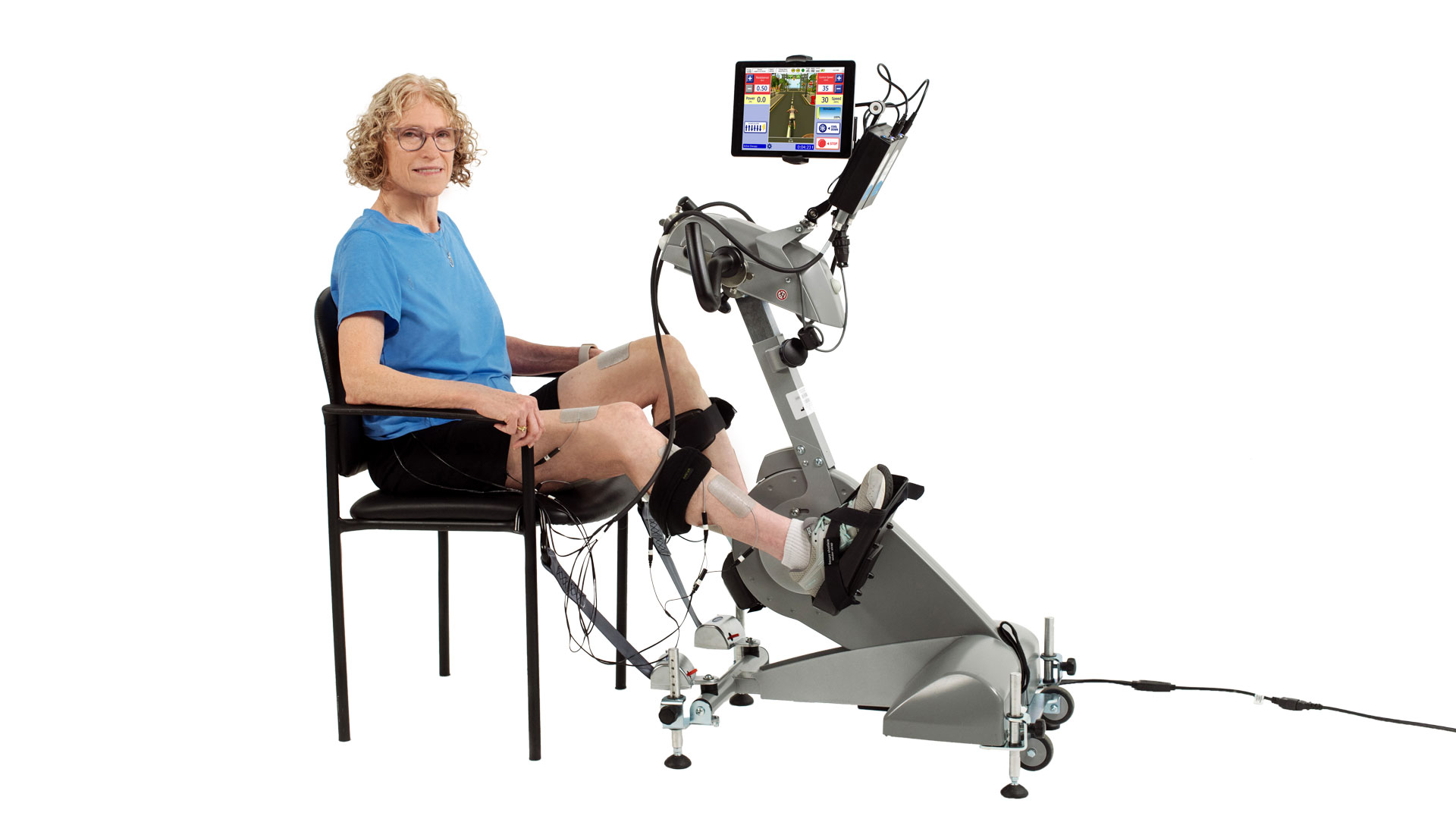
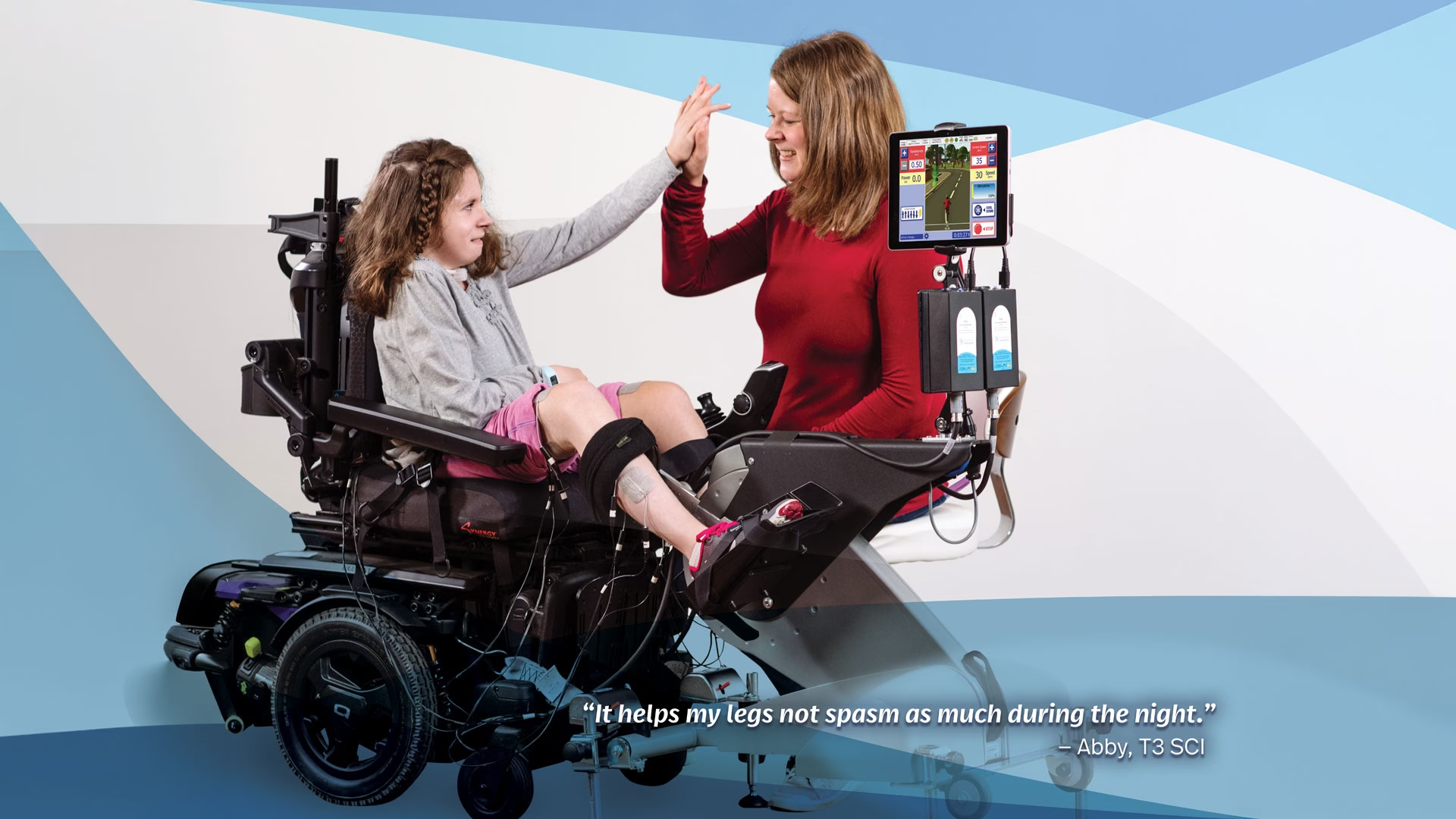
The RT300 Functional Electrical Stimulation (FES) cycle is a therapy system that allows clinicians to deliver large-scale, repetitive neuromuscular activation across the body.
For occupational therapists, this serves as a powerful priming tool before upper-limb sessions.

Clinically, the RT300 can help:
- Relax muscle spasms
- Increase local blood circulation
- Prevent muscle atrophy
- Maintain or increase range of motion
This matters because:
- Reduced tone improves movement quality
- Improved circulation supports tissue readiness
- Repeated activation increases tolerance to activity
Research shows that FES cycling can relax spasticity and improve muscle health and functional outcomes across neurological populations.
When the system is better regulated, functional training becomes more effective.
Task-Specific FES for Functional Recovery with Xcite2
Once tone is better managed, the next step is not passive movement.
It’s function.
The Xcite2 therapy system allows occupational therapists to apply multi-channel FES during real, task-specific activities. This is where therapy becomes meaningful.
Xcite2 supports:
- Muscle re-education
- Relaxation of muscle spasms
- Prevention of disuse atrophy
- Increased circulation
- Maintenance or increase in range of motion
- Immediate post-surgical calf stimulation to prevent venous thrombosis

More importantly, it allows clinicians to:
- Pair stimulation with reaching, grasping, and releasing (and more)
- Train bilateral coordination
- Practice ADLs like feeding, dressing, and object use
Research shows that combining FES with occupational therapy fosters greater improvements in activities of daily living and functional recovery compared to therapy alone (Sun et al.)
Making It Work in Pediatrics: It Should Look Like Play
In pediatrics, none of this should feel clinical. It should look like play.
1. Developmental Weight Bearing for Proximal Stability
- Quadruped crawling races and obstacle courses
- Side-sitting or prone play with toys and books
- Tall kneeling for reaching and midline crossing
2. Layering in Sensory Input
- Vibrating toys or tools along the arm
- Weight bearing on textured or dynamic surfaces
- Animal walks, wheelbarrow races, resistance-based play
3. Transitioning to Task-Specific Play with FES
- Reaching, grasping, and releasing objects
- Sticker placement, peg boards, threading
- Bilateral play and coordination
- Functional tasks like feeding, dressing, or tool use

This aligns with evidence showing that task-specific, repetitive FES-supported training improves functional outcomes and ADL performance.
Putting It Together: A Practical OT Workflow
Here is how this fits into real clinical practice:
Step 1: Prime (RT300)
- Relax muscle spasms
- Increase circulation
- Prepare the neuromuscular system
Step 2: Activate (Xcite2)
- Apply FES during task-specific movement
- Target weak or poorly coordinated muscles
Step 3: Integrate (Occupational Therapy)
- Practice ADLs
- Reinforce motor patterns
- Build independence
Why This Approach Works
Neurorehabilitation is not about inhibition alone.
Lasting change comes from:
- Preparing the system
- Activating it with intention
- Reinforcing it through function
FES-supported therapy has been shown to:
- Increase muscle activation
- Improve voluntary contraction
- Reduce co-contraction
- Enhance functional independence
That is the difference between temporary change and true motor relearning.
FAQ: Occupational Therapy, Spasticity, and FES
What is the best way to reduce upper limb spasticity before therapy?
Priming with sensory input, weight bearing, and FES helps reduce tone and improve readiness for movement.
How does the RT300 help occupational therapists?
The RT300 prepares the system by relaxing spasticity, improving circulation, and increasing tolerance to movement, making functional sessions more effective.
How does Xcite2 improve functional outcomes?
Xcite2 delivers FES during real tasks, helping patients practice meaningful movements and improve ADL performance.
Is FES effective when combined with occupational therapy?
Yes. Studies show improved ADLs and motor recovery when FES is combined with therapy compared to therapy alone.
Can this approach be used in pediatrics?
Yes. Evidence shows NMES and FES are well tolerated in children and can improve function and participation.
Final Clinical Perspective
Lasting change does not come from inhibition alone. It comes from preparing the system, activating it with intention, and reinforcing it through function.
When occupational therapists combine priming strategies with integrated FES systems like RT300 and Xcite2, they are not just relaxing muscle spasms; they are creating the conditions for meaningful, functional recovery.
Explore FES Therapy in Clinical Practice
Learn how RT300 and Xcite2 support functional recovery in neurorehabilitation. Explore our systems or contact our team to see how functional electrical stimulation can fit into your clinical workflow.