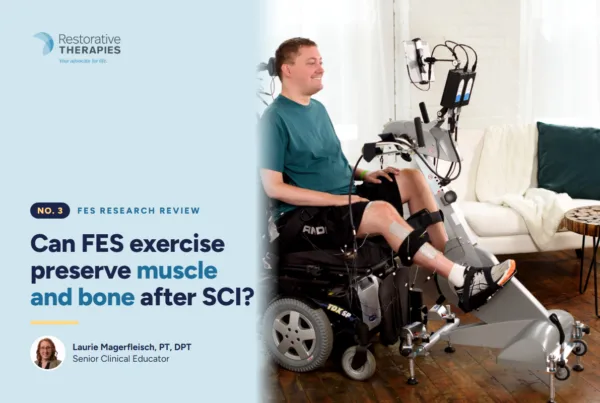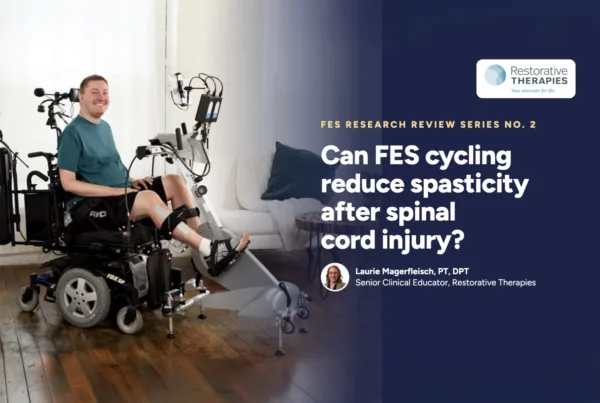

In this installment of the FES Research Review series, we’re looking at a 2025 systematic review and meta-analysis by Xiangli and colleagues examining the effects of FES on respiratory function and aerobic capacity after SCI.
Following spinal cord injury (SCI), reduced muscle activity and limited opportunities for conventional exercise can make maintaining cardiovascular fitness challenging. Depending on the level and severity of injury, individuals may also experience respiratory muscle weakness, further limiting their exercise capacity.
We know that FES can activate muscles that individuals may not be able to contract voluntarily, but can it improve aerobic fitness and respiratory function? Earlier installments in the series looked at FES cycling and spasticity and FES exercise and muscle and bone health.
What Did the Researchers Find?
The review included 23 studies involving 314 individuals with SCI, examining two different applications of FES:
- FES for respiratory function: 12 studies examining electrical stimulation, primarily involving the abdominal muscles.
- FES-assisted exercise: 11 studies examining aerobic capacity during FES-assisted cycling or rowing.
Overall, the researchers found improvements in several measures of respiratory function and aerobic capacity, although results varied depending on the intervention and outcome measured.
FES-Assisted Exercise: Improving Aerobic Capacity
One of the more interesting findings was that adding FES to cycling or rowing produced greater improvements in peak oxygen uptake (VO2peak) compared with exercise without FES.
Both FES-assisted cycling and rowing demonstrated statistically significant benefits, suggesting that activating additional muscle mass during exercise may provide a greater cardiovascular stimulus.
However, the findings were not consistent across all measures. Neither cycling nor rowing demonstrated significant improvements in peak ventilation compared with exercise alone.
Importantly, only two studies contributed to the pooled analysis of VO2peak during FES cycling. While the findings are encouraging, more research is needed to confirm the magnitude and consistency of these benefits.
Respiratory Function: Another Application of FES
The researchers also examined the effects of FES applied to respiratory muscles, primarily the abdominals. FES demonstrated significant improvements in:
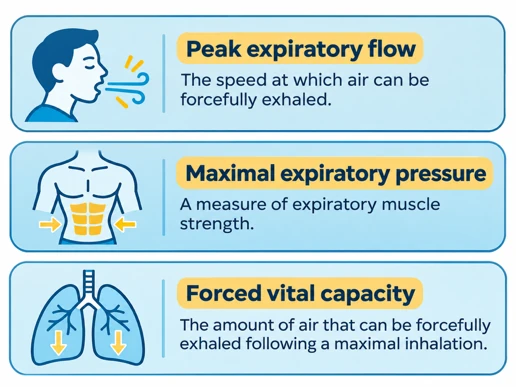
However, there was no statistically significant improvement in maximal inspiratory pressure.
These findings build on earlier research by Butler and colleagues demonstrating that abdominal FES can improve cough effectiveness in individuals with high-level SCI.
McBain and colleagues (2013) found that adding abdominal stimulation during coughing increased peak cough flow by approximately 50%. Following six weeks of FES-assisted cough training, participants demonstrated further improvements in cough pressures and expiratory flow, including improvements during voluntary coughing without stimulation.
McCaughey and colleagues (2015) explored abdominal FES in individuals with acute tetraplegia who required mechanical ventilation. Their small cohort study demonstrated improvements in tidal volume and vital capacity, with participants weaning from mechanical ventilation an average of 11 days earlier than matched historical controls.
Together, these findings suggest that abdominal FES may have applications beyond immediately assisting cough, potentially supporting respiratory training and recovery.
For individuals with higher-level SCI, where impaired abdominal muscle function can affect coughing and airway clearance, these findings are particularly relevant. However, larger controlled studies are still needed to establish whether these physiological improvements translate into fewer respiratory complications or better long-term outcomes.
It’s also important to recognize that these respiratory findings come from abdominal stimulation interventions and should not be interpreted as benefits of FES cycling itself.
What Does This Mean for Clinical Practice?
This review reinforces an important consideration when using FES: activating muscles that are otherwise difficult or impossible to recruit voluntarily may provide opportunities to improve both aerobic capacity and respiratory function.
For individuals with SCI who have limited voluntary lower-extremity movement, FES-assisted cycling and rowing may help engage additional muscle mass and increase the cardiovascular demands of exercise. Similarly, abdominal FES may help improve cough effectiveness and expiratory function in individuals with respiratory muscle weakness, offering both an assistive intervention and a potential training approach.
However, simply adding stimulation does not guarantee a meaningful training effect. The amount of muscle recruited, the work performed, stimulation parameters, and training duration are all important considerations.
We also need to be cautious when interpreting the findings. The studies varied considerably in their protocols, participant characteristics, and outcome measures. Many had small sample sizes, and the evidence is not yet sufficient to establish optimal training parameters.
So, What Do I Want You to Take Away from This?
FES offers opportunities to address some of the cardiovascular and respiratory consequences of SCI, extending well beyond its use for functional movement. The evidence suggests that adding FES to cycling or rowing can improve aerobic capacity, while abdominal stimulation can improve expiratory function and cough effectiveness.
For clinicians, the goal should be more than simply producing a muscle contraction. We need to consider whether the stimulation is providing enough of a physiological challenge to achieve the intended outcome.
Whether we’re using FES for cycling or respiratory training, the important question is not just whether muscles are contracting, but whether we’re generating a meaningful response that can lead to lasting benefits.
RT300 and Xcite2 in SCI Rehabilitation
RT300 and Xcite2 provide complementary ways to incorporate integrated FES into individualized rehabilitation, with applications that address muscle health and functional movement.
RT300: Integrated FES cycling
RT300 combines integrated FES with motor-assisted and resisted cycling to deliver repetitive muscle activation and progressive resistance activity in the clinic and at home. It allows people with weakness or paralysis to engage muscles they may have difficulty activating voluntarily.
RT300 is a physician-prescribed, FDA-cleared system indicated for relaxation of muscle spasms, prevention or retardation of disuse atrophy, increasing local blood circulation, maintaining or increasing range of motion, and muscle re-education. These indications support its role in addressing specific secondary effects of SCI and reduced mobility.
Xcite2: Integrated FES for functional activity
Xcite2 coordinates multi-channel integrated FES with more than 40 task-specific activities for the upper and lower extremities and activities of daily living. Clinicians can incorporate stimulated muscle activation into repeated functional movement practice, selecting activities and settings for each person’s rehabilitation goals. Its approach supports muscle re-education and complements the repetitive cycling available with RT300.
Connecting the research and the technology
RT300 was used in one of the studies included in this review, as part of a combined cycling and arm-exercise protocol. That study’s findings relate to the combined program and cannot be attributed to RT300 alone.
Aerobic capacity and respiratory function are not FDA-cleared indications for RT300 or Xcite2. The abdominal stimulation findings discussed above should not be presented as outcomes of routine use of either system.
Clinicians can refer patients through our Home Therapy Hub.
Frequently Asked Questions
Can FES improve aerobic fitness after spinal cord injury?
The evidence is encouraging. A 2025 meta-analysis found that adding FES to cycling or rowing produced greater improvements in peak oxygen uptake (VO2peak) than the same exercise without FES. Only two studies contributed to the FES cycling analysis, so more research is needed to confirm the size of the benefit.
Does FES cycling improve breathing?
Not directly, based on this review. The respiratory improvements came from stimulation of the abdominal muscles, not from FES cycling. FES-assisted cycling and rowing also did not significantly improve peak ventilation compared with exercise alone.
Which respiratory measures improved with abdominal FES?
Peak expiratory flow, maximal expiratory pressure, and forced vital capacity improved significantly. Maximal inspiratory pressure did not.
Can abdominal FES help with coughing after SCI?
Research suggests it can. In a 2013 study, adding abdominal stimulation during coughing increased peak cough flow by about 50%, and six weeks of training improved cough measures even during voluntary coughing without stimulation.
Can abdominal FES help people come off a ventilator sooner?
A small 2015 cohort study in people with acute tetraplegia found that participants who received abdominal FES weaned from mechanical ventilation an average of 11 days earlier than matched historical controls. Larger controlled studies are needed to confirm this.
Do I need a prescription for the RT300 or Xcite2?
Yes. All Restorative Therapies devices, including the RT300 and Xcite2, require a prescription. Your clinician can help decide whether integrated FES therapy is appropriate for you. Contact Restorative Therapies at 1-800-609-9166 to learn more.
References
McBain, R. A., Boswell-Ruys, C. L., Lee, B. B., Gandevia, S. C., & Butler, J. E. (2013). Abdominal muscle training can enhance cough after spinal cord injury. Neurorehabilitation and Neural Repair, 27(9), 834–843. https://doi.org/10.1177/1545968313496324
McCaughey, E. J., Berry, H. R., McLean, A. N., Allan, D. B., & Gollee, H. (2015). Abdominal functional electrical stimulation to assist ventilator weaning in acute tetraplegia: A cohort study. PLOS ONE, 10(6), e0128589. https://doi.org/10.1371/journal.pone.0128589
Xiangli, J., Ma, B., Liang, Y., Haijiangshi, S., & Liu, X. (2025). Efficacy of functional electrical stimulation alone and as an adjunct to exercise for improving respiratory function and aerobic capacity in spinal cord injury: A systematic review and meta-analysis. Frontiers in Rehabilitation Sciences, 6, Article 1623752. https://doi.org/10.3389/fresc.2025.1623752
Want to learn more about how the RT300 and Xcite2 therapy systems can improve patient outcomes?
Visit restorative-therapies.com to explore how Restorative Therapies supports clinicians and patients in the neurorecovery journey. Explore how the RT300 and Xcite2 therapy systems bring integrated FES into cycling and task-specific functional activity.
Contact Restorative Therapies to schedule a demonstration or clinical in-service. Outside the US? See our international page.
We are your advocate for life.